





Eye For Film >> Movies >> Think Of England (2025) Film Review



They say the first casualty of war is truth, which proves to be just one of the ideas that is put under scrutiny by Think Of England.
Richard Hawkins’ period satire unfolds against the backdrop of the Second World War, although all his characters have been transported to what amounts to a different universe – Orkney – where it soon emerges that none of the usual rules apply. A prologue informs us that, at the same time as Winston Churchill was telling Laurence Olivier to make Henry V in a bid to boost national patriotism, a second filmmaking plan was in action to film three hardcore pornography shorts in a bid to keep up morale (among other things) on the frontline.

If all that sounds suspiciously like the set-up for a modern mix of saucy postcard naughtiness and Ealing comedy then gird your loins because, although there is humour here, there are also some serious targets in Hawkins’ sights. This is about war being fought in a moral maze as he considers the invasion of space owned by others and the way that borders, both physical and ethical, can be redrawn from a very corporeal perspective. It is also a film that, for those who dig into it, has something to say about the modern world's media consumption.
The island crew, in keeping with that nod to Ealing, are a motley sort. Captain Clune (John McCrea) is in charge but barely, with his costume and make-up assistant Agnes Dupré (Ronnie Ancona) seeming much more knowledgeable. Her 18-year-old son Clifford (Ollie Maddigan) is on hand as the sound recordist, while the direction falls to Max Meyer (Ben Bela Böhm) a German Jew who has fled his homeland. The stars of the theoretical show are acting hopeful Holly Spurring (Natalie Quarry) and a bona fide movie star Tyrone Higgs, who in this real-world persona as Corporal Harry Evans (Jack Bandeira) has fallen foul of the authorities and who masters in increasingly unhinged brooding. The wild card on this wild isle is another man (Oscar Hoppe), whose presence nobody knows about.
One thing the film cast and crew share with him, however, is that none of them truly want to be there, having all been coerced for various reasons into their newly constructed roles. The parts people play – and are willing to take on for certain reasons – are at the heart of Hawkins’ considerations. As Agnes astutely notes: “There’s a war on. Most everyone's not who they normally are – why should we be any different?”
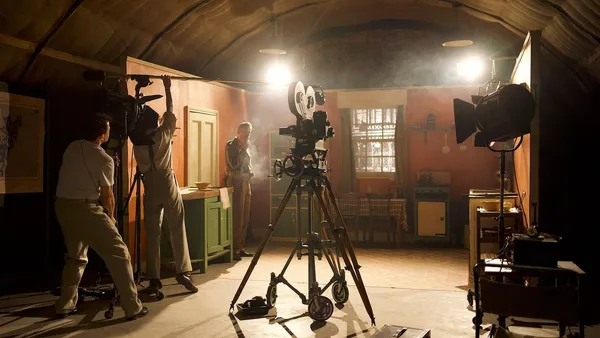
As the Nissen hut shoot unfolds, everyone’s moral compass gets a workout. While having sex might seem straightforward on paper, in practice it becomes a much different question, especially when the leading man has anger issues and a history of violence. Hawkins is taking on an awful lot here, since in addition to the psychological sphere he’s exploring with his characters this is also a consideration of cinema itself and what is allowed or censored. The director and his cinematographer Sarah Cunningham flirt with various styles, adopting the straightforward shooting approach of the period initially but soon mixing it with black and white footage of what is being shot as well as strategically employing much more modern handheld techniques. The production design is also spot on, considering what must have been a tight budget, winning a prize after its world premiere at Tallinn Black Nights.
As the drama becomes increasingly dark, the questions Hawkins asks of the audience stack up, not least how willing we are to play our role in all of this. The answer to that question – and others you may have about the content of the film – will likely lead to viewers’ mileage varying in how far they are willing to go with all this. But you have to hand it to Hawkins, a man who believes in lying forward rather than back.
Reviewed on: 04 Dec 2025


